Why Email Marketing Forms are Still Important
Email marketing is declared dead and finished at least once a month but for anyone that uses it, you still see people sign up for your list and read your emails. One of the key parts of getting those signups is the email marketing forms we have on our websites – but are they still working? Over to HubSpot and the results of their survey.
As an Amazon Associate I earn from qualifying purchases and sometimes recommend products from other sellers at no extra cost you. For more details see my disclosure policy and privacy policy.
Lots of options
There are plenty of ways to capture that important name and email address now – traditional forms, popups, top bars, chatbots, quizzes, live chats and even in Facebook groups. In fact, some websites seem a little chaotic by trying to offer them all. I just have the top bar, for one thing, a pop up for another and a basic little snippet at the bottom of posts (which I know not everyone reaches).
HubSpot carried out a survey of 173 businesses that didn’t work full time in lead capture and generation to see what they found was working for them.
Email marketing forms
The first point was that email marketing forms aren’t dead, any more than email marketing is. 74% of their survey said they used them for lead generations and nearly half said they were the highest converting lead generation tool.
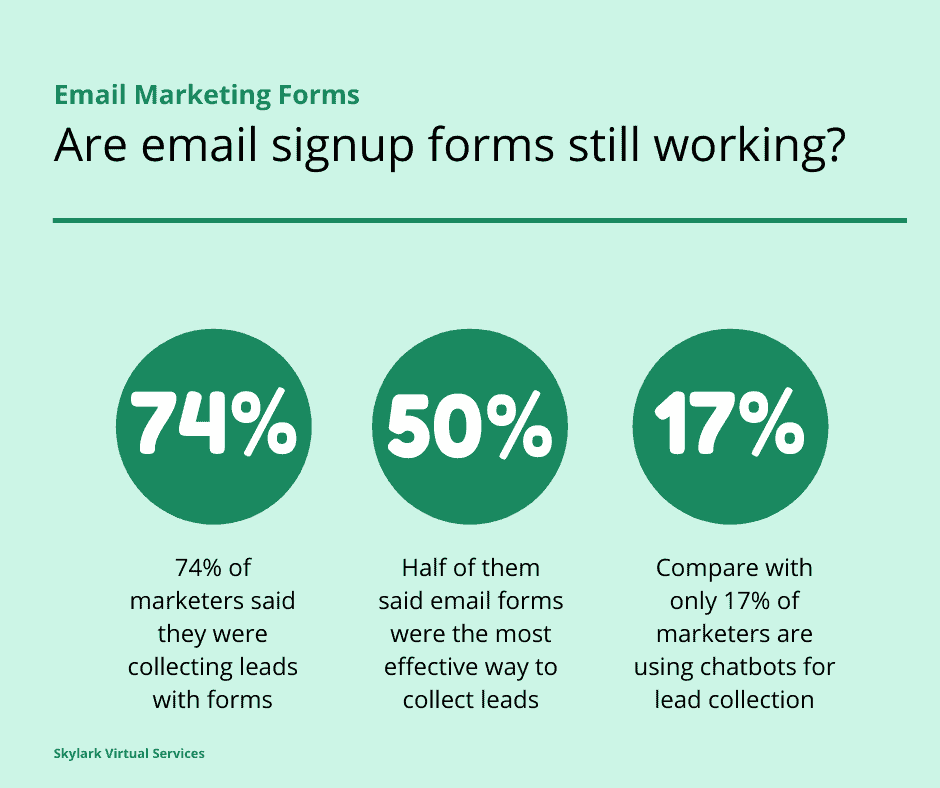
Chatbots may be great for customer service but not so much for email marketing – 17% of marketers are using them but less than 7% said they were the most effective tool. Live chat is still more popular to capture leads and information than chatbots, with 37% of the survey making use of this option.
Forms in action
I was always told to keep information requested on forms to a minimum – for me, that’s first name and email address and the name isn’t compulsory. But the average length of a web form is 5 fields which are interesting – although conversion rates are so variable among the different types of form, there’s no way to clearly see if this is a good or bad thing.
Multi-step forms do have a higher conversion rate for those that use them with an 86% higher conversion rate, although only around 40% of companies use them. Companies that do say they have a 17% higher satisfaction rate with their lead generation work.
Lead magnets
As someone with a blogging background, I have always been told that you have to offer someone something for their email address – a lead magnet, an opt-in freebie, whatever you want to call it.
But HubSpot found only half of marketers are offering some kind of lead magnet for visitors, although the ones that did had a slightly higher email marketing satisfaction rate.
No surprise, eBooks remain the most popular type of lead magnet with nearly 28% of companies using them. Nearly 25% are using webinars and just over 21% are using free tools to entice someone to give their email address. For eBook fans, the average length for a freebie is 5K-10K but rarely any bigger – unless money changes hands!
How to easily make email forms
One of the big things that people run into is that they aren’t sure about what tech they should use to collect those emails. But there are a few different options.
Email marketing software
The simplest is to use the company who you use for email marketing software. In my case, that’s ConvertKit. They have a whole range of forms you can personalise and add into posts, as popups or even to make into bigger landing pages.
MailerLite is the other provider I use for smaller blogs and they have something similar. You can add mockup images and call to action buttons.
Specialist provider
The other option is to go with a specialist provider of email forms. Examples include Sumo and ConvertPlus. My current favourite is ConvertBox which is an impressive app that lets you create all kinds of forms including sign up forms, navigation forms and product promotion boxes that lead to sales pages.
Quantity over quality
There’s still a big emphasis on list size over list quality with only 56% of marketers qualifying their leads. Which means lots of people might have big, impressive-sounding lists but few people interact with their emails so the benefit of this is a little questionable.